
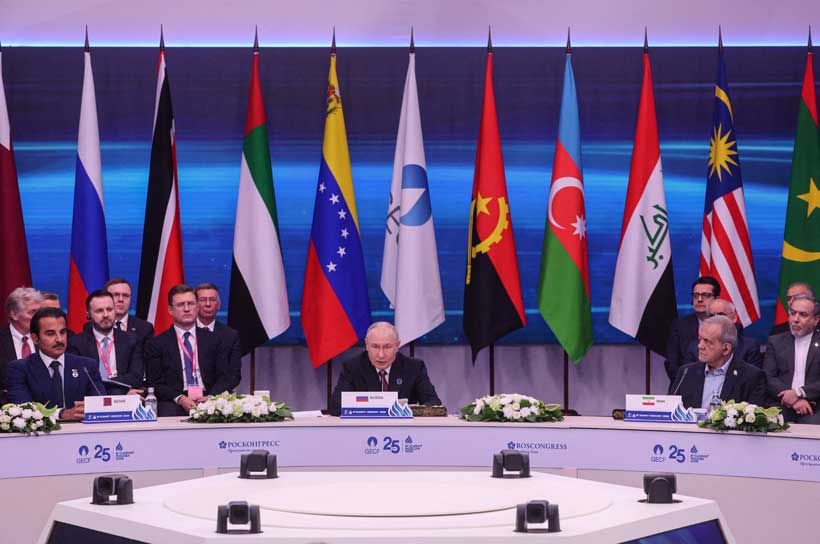
Today, exporting oil and gas to the global markets faces multiple challenges, primarily due to the inability to create new promising commercial prospects, protect the market environment, and ensure greater control by the leaders. Challenges and future opportunities were reviewed and thoroughly discussed during the plenary session of the 8th Summit of Heads of State and Government of the Gas Exporting Countries Forum, held at the World Trade Centre on October 27, 2026.
What’s the Gas Exporting Countries Forum?
It was created 25 years ago, and the Gas Exporting Countries Forum was conceived as an expert and analytical platform for exchanging experience and for assessing and forecasting the gas market. By that description, the group has operated with openness, clarity, and objectivity of assessments crucial for both gas producers and consumers—and for the global energy sector as a whole. The 8th Summit of the Gas Exporting Countries Forum, an organization that unites the leading producers and suppliers of natural gas to the world market.
Exporting countries have made significant contributions to global energy security and balanced development of both individual states and macro-regions. This applies, above all, to the new centers of economic growth—the countries of Asia, Africa, and Latin America—where energy consumption is rising, cities are expanding rapidly, industrial facilities are being built, and electricity use is growing across industry, transport, and the digital economy, including data storage and processing centers.
Stay ahead of the geopolitical week.
MD Briefing delivers expert analysis across five global fronts — the Indo-Pacific, energy, geoeconomics, European security, and the Middle East — every Monday morning. Free.
Gas Exports Experiencing Challenges
The role of natural gas as a pillar of the global energy system, of industry, agriculture, and international trade will continue to strengthen. But this presents a serious challenge for the gas industry, particularly given the upheavals it is currently experiencing. The situation in the Middle East, a key global hub for gas production, has become increasingly tense, with established logistics chains and supply routes disrupted. As a result, the global gas industry now finds itself in a state of uncertainty. Many investment plans have been put on hold, deferred, or even abandoned altogether. Naturally, all of this increases the risk of long-term market imbalance. In these challenging conditions, and given the growing demand for gas, global producers must ensure stable and reliable supplies.
How to Address the Challenges
Notwithstanding the challenges and difficulties and the necessity to address the challenges facing the global gas industry, we should not erect barriers but, on the contrary, strengthen cooperation, primarily among gas-exporting countries. The first and most pressing issue today is the disruption of gas supplies. Therefore, there is the need to optimize transport routes, taking into account the geographical locations of the forum’s member countries and making use of swap arrangements between them. For instance, Russia and its partners have successful experience of multilateral cooperation in maintaining balance in another major hydrocarbon market: the oil market. Joint efforts within the OPEC Plus framework have helped ensure market predictability and stable supply volumes.
Second, global demand for natural gas will continue to grow. This means the need to increase gas supplies, develop new fields, modernize processing facilities, and invest in transport projects, including the development of shipping fleets and infrastructure for the transportation and reception of LNG. Clearly, this is a large-scale, long-term investment. Such investment must be underpinned primarily by long-term contracts. These allow gas buyers to plan energy supplies for their economies, social sectors, and regional development over the long term, while giving suppliers certainty about future sales and enabling them to invest in new projects with guaranteed returns.
Third, another crucial issue for the development of the gas industry is the choice of technologies to be used in gas production projects, transport infrastructure, and specialist training. In this context, there is a need to strengthen technological cooperation among gas-exporting countries and establish close partnerships that bring mutual benefits to all participants. Russia is strengthening its technological sovereignty, including in the gas sector, in a consistent manner. Russia is open to cooperation and the exchange of technological developments within the gas sector. Until quite recently, European partners were working alongside Russia at gas fields and with Chinese partners. Russia is currently exploring the possibility of collaboration with American partners.
The Way Forward and Recommendations
Naturally, based on genuinely focused and constructive discussion, there are several ways to further strengthen mutually beneficial cooperation among producers and suppliers of natural gas and of trends and prospects for the development of the global gas industry. One more surest way is to thoroughly exchange views on the current situation in the international gas market and on what further steps should be taken together to stabilize it and to ensure a fair balance of supply and demand and maintain global energy security.
The final Moscow Declaration emphasizes objectively the growing importance of gas as an affordable and environmentally friendly energy resource for the long-term sustainable growth of the global economy and industry. With a conviction that producing and exporting countries find a balanced development of energy, and in this case, the energy for the metropolis of millions, and most significantly, to ensure a fair balance of supply and demand and maintain global energy security.