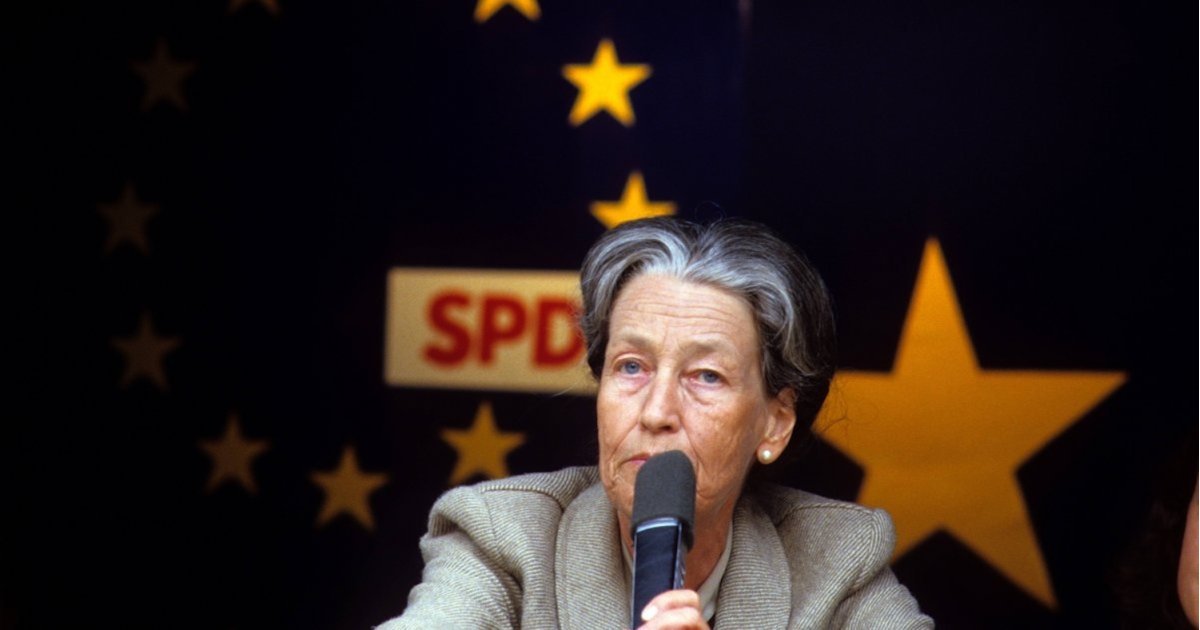
It was none other than the Federal Republic’s first social democratic Chancellor and Nobel Peace Prize winner Willy Brandt who noted in his memoirs, Encounters and Insights, that Katharina Focke ‘repeatedly put everyone to shame with her indestructible belief in Europe’. In fact, Focke had been a staunch advocate of a united, federal Europe for almost her entire life.
Born in Bonn in 1922 as Elsbeth Charlotte Katharina Friedlaender, Focke was the eldest of four children. Her parents, Ernst and Franziska Friedlaender, moved her first to Berlin and then, in 1929, to New York. There, her father had been able to take up a senior position at the Agfa corporation. But when Agfa’s headquarters asked him to return to Germany in 1931, he refused. As the son of a Jewish father who had converted to Protestantism, he feared reprisals against his family.
Having become wealthier in New York, the family was able to travel across Europe in search of a new life. After short stays in Denmark, France, Italy and Switzerland, the family settled in Liechtenstein in 1934, where they remained throughout the anti-Jewish pogroms and the Second World War until 1946. While in exile, her father became preoccupied with the future of Germany after national socialism. When they returned, he became the Deputy Editor-in-Chief of Die Zeit.
Her father’s main concern was West Germany’s ties to the Western world and the unification of Europe, and he became President of the Union of European Federalists in West Germany. Focke inherited her father’s passionate belief in Europe. Pursuing a career in diplomacy, she was a doctorate candidate in Political Science at Oklahoma. Her dissertation on European politics, The Nature of the Supranational, was to send her life in a different direction than she imagined.
From academia to a cabinet position under Brandt
In 1954, the same year Focke received her doctorate, she married Ernst-Günter Focke, Secretary General of the European Movement in West Germany. Having met her husband conducting interviews for her dissertation, she committed herself to supporting his political career and became well-known within the pro-European side of West German politics. But in 1961, his death at the age of 47 led her to pursue a political career of her own.
Focke became the Managing Director of the European Policy Education Institute (EPEI) and also joined the Social Democratic Party (SPD) in 1964, being elected to the North Rhine-Westphalia Parliament just two years later. Just one of three women in a Parliamentary grouping of 99, this experience of being a woman in politics prepared her to stand for the Bundestag in 1969. Her unconventional, modern campaign meant she secured the SPD’s largest swing of any constituency.
Brandt, who already knew Focke through her work in the EPEI and was impressed by this achievement, subsequently appointed her to be his assistant as the Parliamentary Secretary to the Chancellery. In this role, she was primarily responsible for coordinating Western European policy. One of her biggest achievements was preparing the West German position for the European Economic Community (EEC) summit in The Hague in 1969.
In large part as a result of Focke’s preparations, groundbreaking declarations of intent on the enlargement of the EEC were made by its member states. Throughout the summit, as with every other meeting she attended in this role from 1969 to 1972, she was the only woman on the European political stage. The results of the summit in The Hague and her diplomatic skills as a polyglot attracted the attention of figures as prominent as Jean Monnet, but she eventually accepted a promotion to the Brandt cabinet as the Federal Minister for Health.
Focke continued in her role in the first cabinet of Helmut Schmidt, but she did not continue into the second Schmidt cabinet and became a backbencher in 1976. Three years later, she chose to stand as a candidate for the SPD in the first direct elections to the European Parliament. Being successful in her candidacy, she served as both an MP and an MEP until the 1980 West German federal election.
The first female lead candidate for the SPD
As a sole MEP, Focke devoted herself primarily to development policy and was heavily involved in the successful trade negotiations between the EEC and the Asia, Caribbean and Pacific states, known as the Third Lomé Convention. In this time, the Working Group of Social Democratic Women campaigned for her to be the lead candidate in the 1983 European elections, marking the high point of her political career.
Focke continued to be a pioneer of unconventional campaigning methods, through tactics that included touring throughout West Germany with a circus consisting of artists from all of the EEC member states. But because of a lack of support from her party’s Executive Committee, with European politics seen as secondary, as well as being dismissed and undermined as a woman, she was unable to repeat her past electoral success.
Returning to developmental policy, Focke continued to be an active and passionate MEP and held a role as a committee chair until her retirement from Parliamentary politics in 1989. In her hometown of Cologne, she continued to campaign for the rights of asylum seekers and refugees with roles in non-governmental organisations until her death in 2016 at the age of 94. When she passed away, Europe lost a pioneer for women in its politics.