Brussels still believes wars are fought over territory, trade routes, deterrence and rational state interests. Washington, Teheran and Jerusalem no longer do. The ongoing war that we are witnessing in Iran is not merely geopolitical; it is theological. Not because Christianity, Judaism and Islam are inherently violent religions, but because political movements inside all three are increasingly interpreting history itself through sacred destiny. What we are witnessing is the gradual collapse of secular realism and the return of apocalyptic politics.
The post-Cold War fantasy that religion had been permanently subordinated to liberal economics is disintegrating in real time. Across the Middle East and increasingly inside the United States itself, political legitimacy is once again being fused with prophecy, civilisational identity, and eschatology. The modern world is drifting back toward a pre-modern mindset where war is not simply strategic, but sacred. And sacred wars obey different rules.
Iranian revolution has always been religious
The regime in Iran already defines itself through sacred struggle. Since 1979, it has fused Shia martyrdom theology with anti-Western revolutionary politics. Resistance against Israel and the United States is not presented merely as strategy, but as a religious obligation. Yet, Western observers consistently underestimate the power of martyrdom in Shia political culture.
Throughout much of Islamic history, Shia communities existed as minorities surrounded by larger Sunni powers. This historical experience helped create a political theology centred not primarily on triumph, but sacrifice. The righteous minority stands against overwhelming force, and death in defence of truth becomes a victory rather than a defeat.
Every Israeli strike and every American threat strengthens precisely the factions within Iran that interpret the conflict through jihadist and messianic frameworks. Tehran’s rulers understand that external pressure radicalises the population and restores ideological legitimacy to a regime that would otherwise struggle under economic stagnation and social exhaustion. But this dynamic is not unique to Iran.
The theology of imperial decline
The most uncomfortable reality lies in Washington. The United States is behaving less like a confident superpower and more like a late-stage empire confronting the limits of its own power. Like many declining empires before it, America increasingly compensates for weakening legitimacy through moral absolutism and mythological self-understanding. Empires in ascent tend to be pragmatic. Empires in decline become theological.
The United States can no longer dominate the global economy the way it once did. It can no longer decisively win prolonged wars. Its political system is paralysed internally. Its social cohesion is fraying. Its prestige has been damaged by decades of military overreach. Yet, declining powers rarely acknowledge decline. They seek symbolic victories to restore purpose and narratives to transform uncertainty into destiny. This is where religion enters.
American politics is becoming deeply religious
The most influential force pushing confrontation with Iran is not the military-industrial complex nor the most hardline, neo-conservative members of Congress. It is the alliance between the pro-Israel lobby that provide funding in crucial Senate races to Democrats and Republicans alike on the one side, and various groups of evangelical Christians who assess the conflicts in the Middle East through biblical prophecies.
For millions inside the American evangelical movement, Israel is not simply an ally. It is the stage upon which the final act of history will unfold. Within influential strands of dispensationalist theology, war in the Middle East is not viewed solely as a tragedy to avoid. It is part of a prophetic sequence leading toward the Second Coming of Christ. Conflict surrounding Jerusalem, regional chaos and escalating confrontation with hostile powers are read as signs that biblical prophecy is unfolding.
In this worldview, peace itself can become spiritually suspicious because indefinite peace delays prophecy. This is no longer a fringe theology operating in distant isolation from political power. Over the past two decades, televangelists, apocalyptic pastors, and Christian nationalist ideologues have moved closer to the centre of Republican politics. They now have a major influence over the public, the media, and mainstream political narratives.
Armageddon has entered American foreign policy
The result is a powerful symbiosis where the most extreme Zionists gain unconditional support for Israel’s foreign policy, while evangelical movements gain a geopolitical theatre upon which their apocalyptic theology can unfold. The relationship is mutually reinforcing: one side seeks strategic supremacy and the other seeks prophetic fulfilment. Conflict in the Middle East is interpreted not as diplomatic failure, but as prophetic inevitability.
Escalation becomes spiritually meaningful. War ceases to be something to avoid and becomes something that confirms belief. The most alarming possibility is not that governments officially adopt apocalyptic doctrines. It is that enough people in positions of power genuinely believe them to shape the environment in which decisions are made. When military confrontation begins to be discussed as part of a divine plan rather than merely a strategic calculation, the line between statecraft and eschatology starts to disappear.
The most extreme believers always win
Once politics becomes eschatological, there remains no room for moderation. The logic of apocalyptic movements is always the same. The most radical factions eventually set the agenda because they are the only actors psychologically prepared for unlimited escalation. Moderates think in terms of compromise, diplomacy and equilibrium. Apocalyptic actors think in terms of destiny, purification and final confrontation. Over time, the moderates lose influence because they appear weak, faithless or naïve inside systems increasingly driven by existential fear.
Every Israeli bombing campaign and every American escalation validates the Islamic Republic’s narrative that the West is conducting a civilisational war against Islam itself. The harder Washington leans into biblical rhetoric, the easier it becomes for Tehran to mobilise Shia apocalypticism and jihadist sentiment in return. Each side radicalises the other. American Christian apocalypticism strengthens Iranian religious militancy. Iranian militancy strengthens Israeli siege mentality. Israeli nationalism strengthens evangelical prophecy culture. And the cycle accelerates.
Europe still thinks geopolitics is secular
This is why the ongoing conflict is so dangerous. The escalation is no longer purely military. It is psychological, theological and civilisational. Europe remains intellectually unprepared for this transformation because European elites still operate within a post-religious framework created after the Second World War and seemingly confirmed by the end of the Cold War.
This framework assumes all actors fundamentally seek stability, prosperity and institutional equilibrium. But civilisations entering periods of decline often stop seeking stability. They seek meaning. And meaning is infinitely more dangerous than oil. European policymakers continue interpreting religious rhetoric metaphorically even as many of the actors involved increasingly mean it literally.
It also assumes that the world operates according to the scientific method and rational modes of liberal thinking. But much of the world has already moved into a post-rational period that is driven instead by identity, mythology and sacred history. What will it mean for geopolitics and Europe’s role if rational self-interest no longer contains conflict and the actors driving world affairs see themselves as participants in a sacred history?
The road ends in Jerusalem
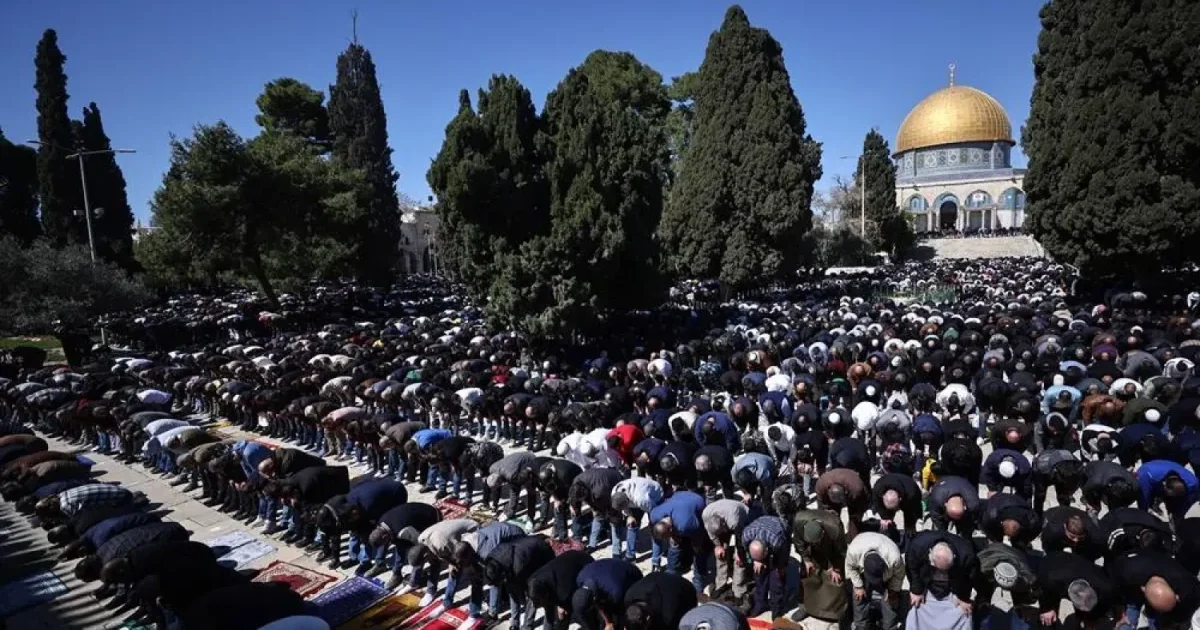
Every major eschatological tradition involved ultimately converges on Jerusalem, which raises many uncomfortable questions. Could this end with the destruction of the Al-Aqsa Mosque? Could a regional war create the political conditions for the construction of a Third Temple on the Temple Mount? Most policymakers dismiss such questions as fantasy, but throughout history events considered impossible often became inevitable only a few years later.
The danger is not everyone believing in these prophecies. The danger is that not enough people take them seriously. If Jerusalem is allowed to serve as the centre of a confrontation between competing messianic movements, the world will find itself closer to war on a global level than at any point since 1945. The twentieth century was defined by ideological wars. The twenty-first may be remembered for the return of sacred ones.